
The midterms are less than a week away, and your voice needs to be heard!
As South Asian American voters, our voices are underrepresented at the polls. From issues that affect our families to policies shaping our futures, every vote has the power to make a difference.
Navigating the midterm elections can feel overwhelming. That’s why we have put together this guide covering everything you need to know to vote by November 3rd.
What are Midterm Elections?
Midterm elections occur halfway through a president’s four-year term, when voters elect members of Congress, including all 435 House seats and roughly one-third of the Senate. This year, Illinois voters will also elect our Governor, Lieutenant Governor, Attorney General, and more state and local officials.
Midterms are often confused with primaries, which happen before the general election and help determine which candidates will represent each political party on the ballot. The two are often confused because primaries can take place in a midterm election year, but they serve different purposes. Primaries help choose the candidates, while midterms determine who gets elected.
Chicago voters will also have a municipal election early next year, when they can elect their mayor on February 23, 2027.
Why is South Asian American Voter Engagement Important?
In our upcoming Strengthening Democracy: The Right to Vote report, we found that in each of the five November general elections from 2016 through 2024, South Asian American voter turnout in Chicago trailed the non-South Asian electorate by 13 to 20 percentage points. In the 2024 general election, turnout reached 57.7 percent among South Asian American voters, compared with 71.9 percent among non-South Asian voters.
Elections, including midterm and municipal ones, influence decisions about our schools, healthcare, immigration, public safety, and more. Voting lets communities shape these policies by choosing the representatives who make these vital decisions.
Despite being one of the fastest-growing populations in the country, the South Asian community has often been left out of these key political decision-making processes. Our upcoming report focuses on the city of Chicago and examines South Asian American civic participation through voter registration, turnout, and broader forms of community engagement.
Our research also found that in the last election, turnout among non-South Asian voters followed the familiar pattern seen in many American electorates, rising steadily with age from 61.2 percent among 18-to-24-year-olds to 75–76 percent among voters 55 and older. South Asian voter turnout, however, followed a different pattern. It rose through middle age, peaking at 62.9 percent among 45-to-54-year-olds, before declining among older voters. South Asian voters aged 65 and older turned out at just 52.7 percent, below the turnout rate of South Asian American voters in their twenties.
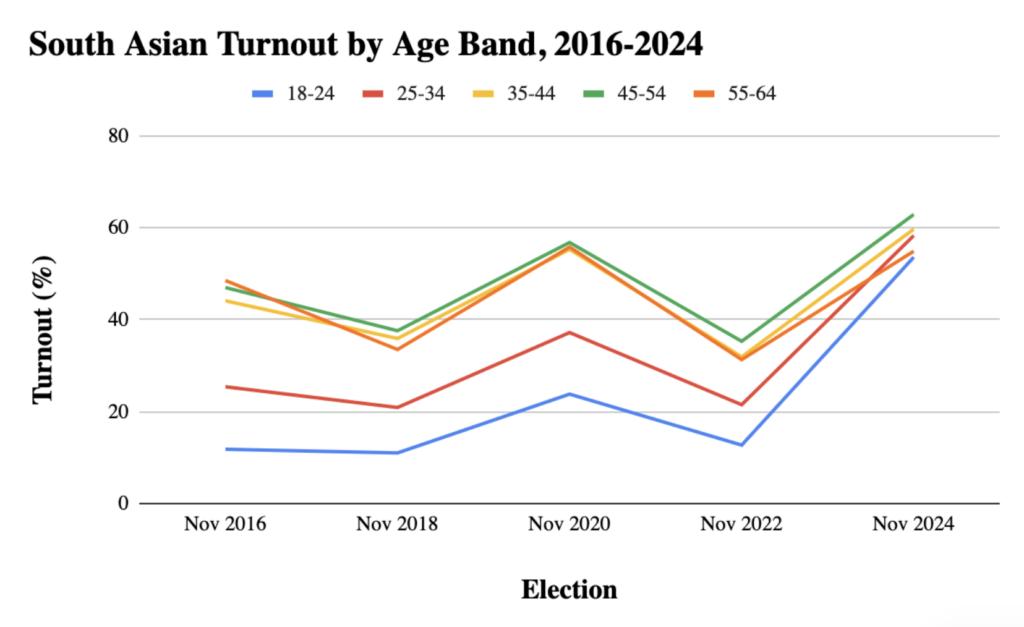
Source: Strengthening Democracy: The Right to Vote Report, SAAPRI 2026
You can learn more about our other findings here.
You can be the first to hear about the release of our report by subscribing to our newsletter: https://saapri.us6.list-manage.com/subscribe?u=08bb913f48&id=7cd373d9f5
The South Asian American turnout gap in Chicago is not evidence of disengagement, but rather reflects a community whose participation is shaped by structural conditions. One way to address these structural barriers, as highlighted in our language access report Addressing and Overcoming Language Inequity in Elections, is to expand language assistance and recruit bilingual poll workers to provide support.
We also encourage you to have conversations with your family and community members on the importance of voting and accompanying those who need transit or language support to the polls. These conversations can make voting more accessible and potentially increase voter turnout among the South Asian American community.
What Will I See on My Ballot?
Depending on where you live, your ballot may include candidates for local, state, and federal offices, as well as ballot measures on important public issues. During midterm elections, voters across the country elect all 435 House seats and roughly one-third of the Senate. Understanding what appears on your ballot before Election Day can help you make informed decisions and ensure your voice is represented in the democratic process.
One great way to make sure you are informed about all the candidates and issues on your ballot is to look up your sample ballot before Election Day. A sample ballot allows you to see which candidates are running for office and which ballot measures you will be asked to vote on, giving you time to research your options and understand the issues.
Here are some links to look up your sample ballot:
Chicago’s School Board Races
This year, for the first time, Chicagoans also have the opportunity to elect the full Board of Education, including 20 members representing districts and an at-large president.
Chicago’s Board of Education, or the “School Board,” governs Chicago Public Schools. Board members’ duties include passing yearly budgets, approving the appointment of Chicago Public Schools CEO, approving and negotiating contracts with organized labor and vendors, and passing resolutions regulating all elements of school district life from academics to environmental safety. School board members make key decisions about curriculum and school funding, two issues that significantly impact the South Asian community.
All voters in the City of Chicago will have two School Board-related questions on their ballot: who to elect as Board President and who to elect as their local district’s Board Representative.
You can look up and learn more about the Board President and School Board Candidates below.
Grace Period Registration
Forgot to register to vote? No worries. Illinois elections have grace period registration, allowing you to register through Election Day at designated polling sites. You can look up polling sites that allow grace-period registration here. All Cook County voting sites offer grace period registration.
To register at the polling site, you must bring two forms of ID or proof of residency. The state allows for several types of ID, including passports, driver’s license, student ID, pay stub, lease, medical bill, or mortgage. Here is the full list of acceptable IDs. At least one of them must list your current address. For example, your state driver’s license with an old address plus a copy of a ComEd bill with your current address will work.
Language Access and Accessibility at the Polls
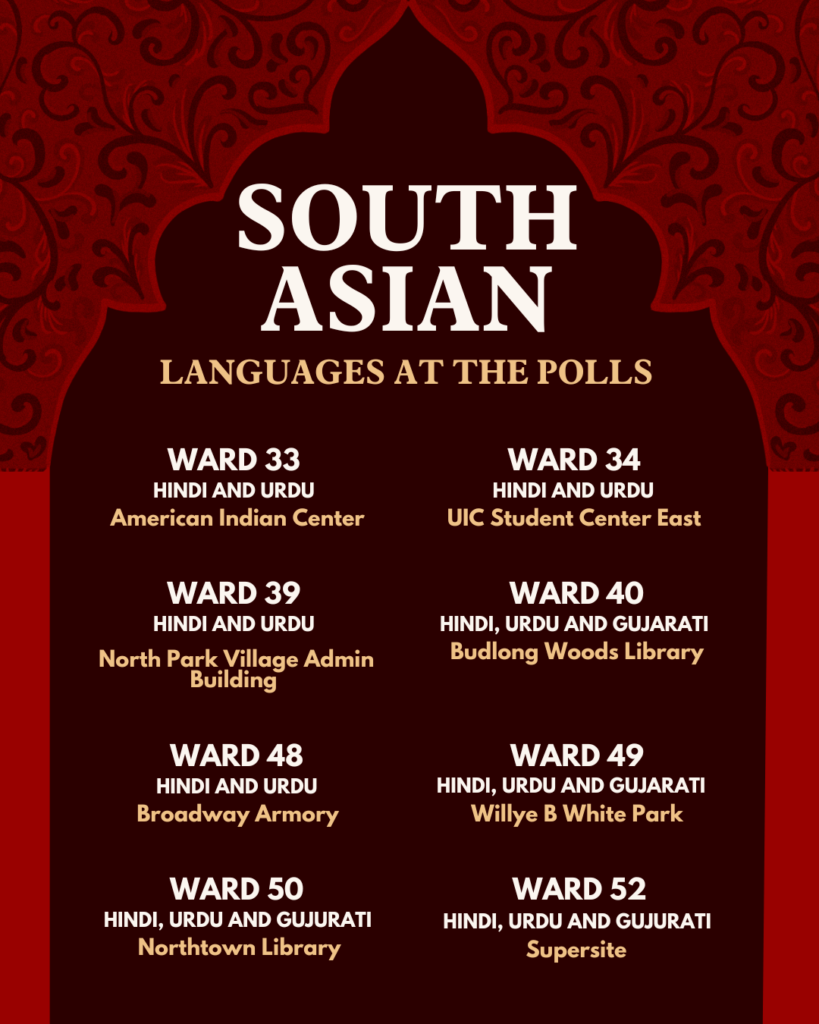
Every voter should be able to participate in elections with confidence. Language assistance at the polls can help voters who prefer to communicate in a language other than English understand the voting process and cast their ballots. Chicago offers language assistance in Hindi, Urdu, and Gujarati at certain poll locations.
Chicago voters can also access voting at any Early Voting or Vote Center location throughout the city, regardless of where they live, allowing them to choose the site most convenient for them, including on Election Day.
All locations are ADA-compliant and fully accessible to voters with disabilities. The Chicago Board of Elections also provides various accessibility devices and tools, including ballot marker grippers, magnifying lenses, and more.
Election Protection Hotline
Every voter deserves the opportunity to cast their ballot safely, confidently, and without barriers. The Chicago Lawyers’ Committee for Civil Rights is supporting this effort through the nonpartisan Election Protection hotline at 866-OUR-VOTE, where trained volunteers will answer voters’ questions and help address concerns across Illinois.
Nonpartisan poll watchers will also be on the ground in Chicago and surrounding counties to assist voters facing challenges such as voter intimidation, polling place closures, language or disability access barriers, or electioneering.
Community Bulletin

SAAPRI Informational Sign Up Form
Help shape research and policy impacting South Asian American communities. Join SAAPRI’s Community Research Listserv to receive occasional opportunities to participate in surveys, focus groups, and research initiatives focused on issues affecting our communities, including healthcare, civic engagement, immigration, and more.
South Asian Education on Health, Aging, and Transitions Webinar
South Asians are one of the fastest-growing populations in the United States but remain underrepresented in aging and Alzheimer’s research. To address this gap, SAAPRI and SAPHA hosted an October 22 webinar bringing together clinicians, researchers, and community members to discuss how culture, chronic health conditions, and caregiving shape aging experiences in South Asian communities.