
U.S. citizenship is a cornerstone of civic participation. Acquired either at birth or through naturalization, it represents a critical legal status with lasting impacts for individuals and families. The September 2026 Access to Justice newsletter summarizes the Supreme Court’s recent decision on birthright citizenship and accompanies our naturalization data brief.
Supreme Court Reaffirms Birthright Citizenship
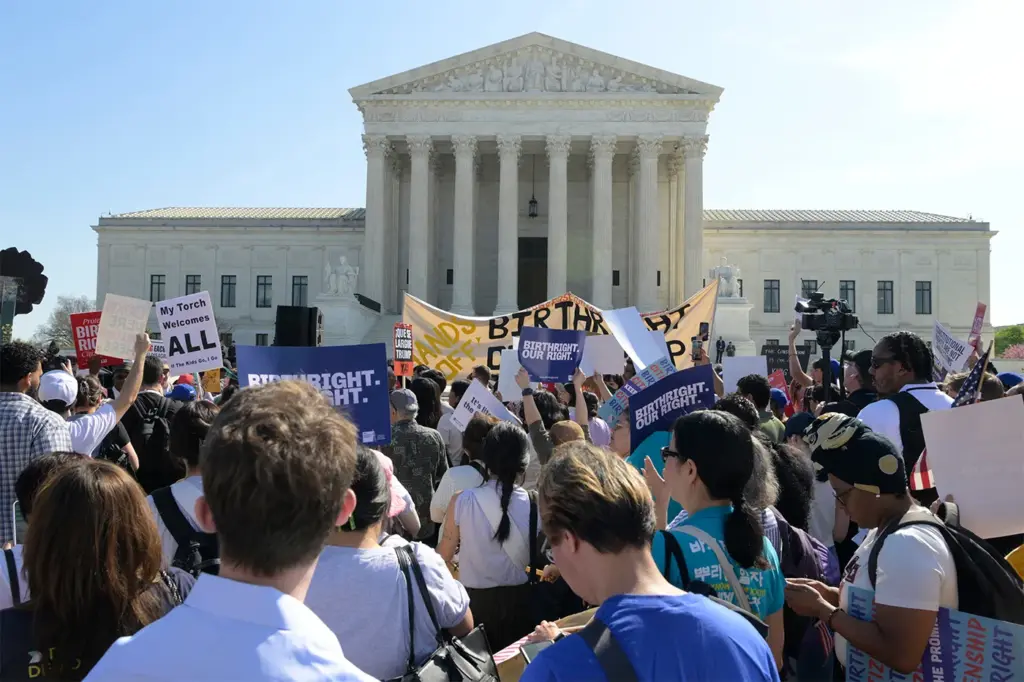
Demonstrators from the American Civil Liberties Union (ACLU) hold a rally outside the Supreme Court to defend the 14th Amendment and birthright citizenship. Photo by Lenin Nolly/Sipa USA via AP Images
In 2025, President Trump issued Executive Order 14160: “Protecting the Meaning and Value of American Citizenship” with the goal to deny citizenship to children born in the U.S. to certain noncitizen parents (The White House, 2025). On June 30, 2026, the U.S. Supreme Court upheld the principle of birthright citizenship in Trump v. Barbara (SCOTUSBlog, 2026). The Court held that children born in the United States to parents who are either undocumented or temporarily present in the country are “subject to the jurisdiction” of the United States under the Fourteenth Amendment. Therefore, they gain U.S. citizenship at birth, with a few long-recognized historical exceptions, such as children of accredited foreign diplomats or occupying foreign military forces.
Birthright citizenship in the United States is grounded in the Fourteenth Amendment of the Constitution, which guarantees that “All persons born or naturalized in the United States, and subject to the jurisdiction thereof, are citizens of the United States and of the State wherein they reside” (U.S. Congress, n.d.).
The Supreme Court ruled that executive order 14160 conflicted with the Fourteenth Amendment. The majority based its ruling on the constitutional text, the historical principle of jus soli or citizenship based on place of birth, along with longstanding Supreme Court precedents, including the decision in United States v. Wong Kim Ark (Justia, n.d.). The Court found that individuals in the United States, including those without legal status or those temporarily present, are still subject to U.S. laws and jurisdiction, meaning their U.S.-born children qualify for citizenship under the Constitution. The majority further stated that the Constitution does not allow the Executive Branch to create new exceptions to birthright citizenship based on parents’ immigration status.
Despite the court’s rulings, policy discussions continue. Following the decision, the Trump administration announced plans to pursue additional legal and policy avenues related to birthright citizenship (Dallas, 2026). This suggests that further legal challenges or executive actions may occur. At the same time, Members of Congress have introduced legislation addressing the issue, including the introduction of H.R. 9633, the Birthright Citizenship Clarification Act of 2026. If passed, the legislation would amend the Immigration and Nationality Act to deny birthright citizenship to children whose parents do not have permanent legal status. While the Supreme Court has established the current constitutional framework, conversations around birthright citizenship are likely to continue in the months ahead (U.S. Congress, 2026).
The decision is especially relevant for South Asian American communities. Many families in the community include first-generation immigrants who initially entered the United States on temporary visas, such as employment- and student-based visas, before pursuing permanent residence or naturalization. For these families, U.S.-born children have traditionally been recognized as citizens under the Fourteenth Amendment, regardless of their parents’ immigration status. The Court’s decision maintains this longstanding constitutional principle and provides stability for families navigating various immigration processes.
Introducing Data Briefs
South Asian Americans have a long history in this country dating back to before the 19th century. Much of their arrival and history since then can be traced by the evolution of the U.S. immigration system. And yet, there has not been a concentrated effort to review the disaggregated data documenting the legal processes that govern the roughly 6 million South Asians who call the United States home. This is the first in a series of data briefs by SAAPRI that take a deep dive into the patterns of South Asian immigrants in the U.S.

Sikh immigrants arriving at Angel Island. Photo from Angel Island Archives.
South Asian American Naturalization
Naturalization is defined as the process by which a person born outside of the United States obtains U.S. citizenship. In order to obtain citizenship, the United States Citizenship and Immigration Services (USCIS) have identified the following criteria:
- Be at least 18 years of age
- Show that you are a lawfully admitted permanent resident of the United States
- Have resided in the United States as a lawful permanent resident for at least five years
- Have been physically present in the United States for at least 30 months
- Be a person of good moral character
- Be able to speak, read, write and understand the English language
- Have an understanding of the fundamentals of the history, and of the principles and form of government, of the United States
- Demonstrate attachment to the principles of the Constitution and be well-disposed to the good order and happiness of the United States
- Be willing and able to take the Oath of Allegiance
Individuals who meet the following criteria may apply for citizenship by completing a form known as N-400, participate in background checks conducted by the Federal Bureau of Investigation (FBI) and provide required documents verifying their adherence to the criteria. Once completed, an interview is scheduled for individuals with a USCIS officer followed by a naturalization ceremony once the officer confirms eligibility (USCIS, 2026).
The naturalization process is an important pathway to citizenship for many South Asian Americans. To better understand the impact that the naturalization process has had on the South Asian community in the United States, we reviewed over 20 years of data from the Office of Homeland Security Statistics.
All data depicted is based on South Asian immigrants’ country of birth. Countries of birth included are Bangladesh, Bhutan, India, Maldives, Nepal, Pakistan and Sri Lanka. This excludes South Asians who may identify with a South Asian country of origin but were born elsewhere in the world (e.g. An Indian origin person born in Guyana).
In addition, all numbers are shown as represented by the Office of Homeland Security Statistics. In the dataset, cells are listed as “D” when a country of origin does not meet disclosure standards.
Trends for Naturalization
The following charts showcase the naturalization trends for those born in Bangladesh, India, Nepal, Pakistan and Sri Lanka from 1991 – 2024. Based on this data, South Asian born naturalized citizens have increased over the past two decades, albeit at different rates. Nepal did not see much of an uptick in naturalized citizens until 2008.
Naturalization Totals
The following chart shows a total number of South Asians naturalized in the United States from 1991 – 2024 (with the exception of those born in Bhutan and Maldives). The highest point for total South Asian born naturalizations was in 2022. The lowest point for total South Asian born naturalizations was in 1998. Indian-born immigrants consistently make up the highest number of naturalized citizens based on immigration volumes. From 1991 – 2008, Nepalese-born immigrants made up the lowest number of naturalized citizens based on immigration volumes. Since 2008, Sri Lankan-born immigrants have made up the lowest number of naturalized citizens based on immigration volumes.
Fewer immigrants from all five South Asian countries of birth mentioned below have been naturalized as a U.S. citizen since the highest point in 2022.
The following chart examines naturalizations of immigrants born in South Asian countries (with the exception of Maldives) over the past decade (2014–2024), comparing the top 15 destination states with national naturalization trends.
In all cases, more than 85% of naturalized citizens born in South Asia are naturalized in one of the 15 states. This means, less than 15% of naturalized citizens born from South Asian countries are naturalized in the remaining 35 states.
The chart below also highlights the changes in naturalization rates for the Top 15 states from 2014 to 2024. All states have seen an increase in naturalizations of South Asians over the past decade.
It should be noted that total (South Asian and Non-South Asian) naturalizations have also seen an increase across all states. In 2014, total naturalizations were at 653,416 and in 2024 they were 818,570. This indicates a 20.2% increase in naturalizations over the past decade.
Although states like California and New York consistently rank at the top for number of South Asian born naturalizations, states like Washington and North Carolina have seen significant growth in naturalization rates for South Asians over the past decade.
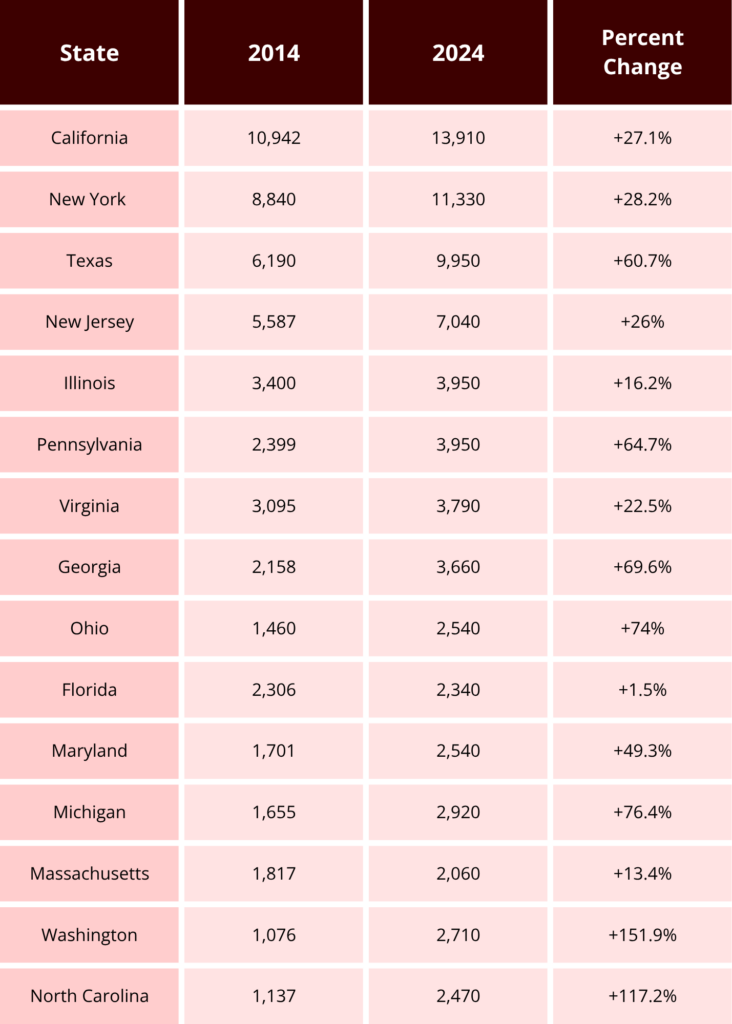
In order based on the average of 2014 and 2024 naturalizations. Percentages rounded to the tenth degree.
Top 50 CBSAs for Naturalizations in 2010 and 2020
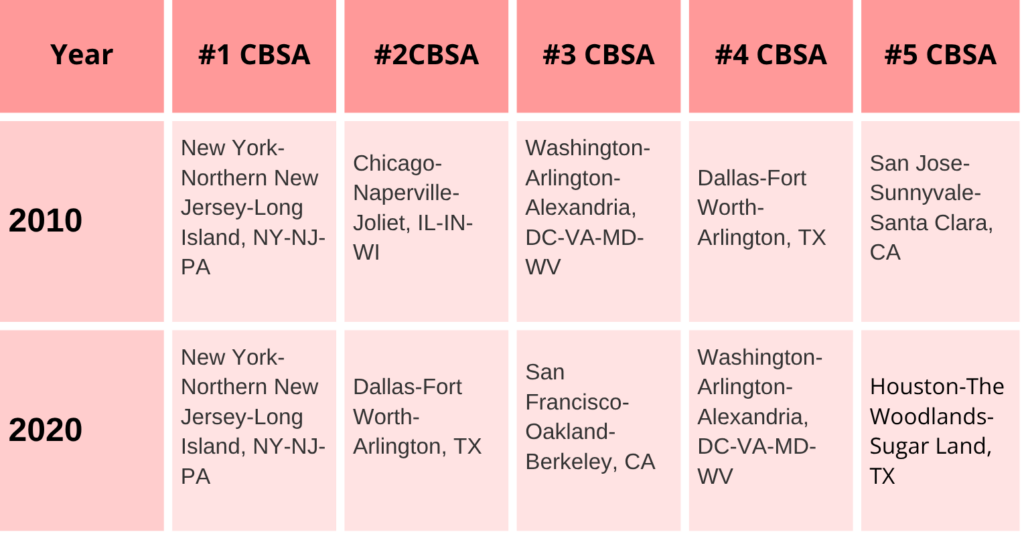
These two charts show South Asian born naturalizations in descending order for the Top 50 Core Based Statistical Areas (CBSAs) in 2010 and 2020.
Top 5 CBSAs for Naturalizations in 2010 and 2020
**CBSA is defined by the Office of Homeland Security Statistics as a statistical geographic entity consisting of the county or counties associated with at least one core (Urban Area) of at least 10,000 population, plus adjacent counties having a high degree of social and economic integration with the core as measured through commuting ties with the counties containing the core. Metropolitan and micropolitan statistical areas are the two categories of Core Bases Statistical Area (CBSAs).
When comparing the charts, the top CBSAs for South Asian born naturalizations have changed with Dallas-Fort Worth-Arlington TX having the second most South Asian born naturalizations in 2020 vs. Chicago, Naperville, Joliet had the second most in 2010.
In addition to a change in order, some new CBSAs have been identified in 2020 vs. 2010 such as Bakersfield, CA.
Deeper dive into CBSAs for Naturalizations in California and Texas in 2010 and 2020.
For the purposes of this analysis, we focused on the two states that had the greatest number of CBSAs within its borders without overlapping to another state. This allowed us to isolate naturalization patterns within a state to indicate some level of migration patterns of South Asians within the state.
The following charts look at California and Texas to compare naturalizations taking place in one of the top 50 CBSAs vs. the rest of the state in 2010 and 2020 (with Metropolitan Cities) comparison.
In California, the top 3 CBSAs (Los Angeles-Long Beach-Santa Ana, San Francisco-Oakland-Fremont and San Jose-Sunnyvale-Santa Clara) were close to each other in total South Asian born naturalizations in 2010. However, by 2020, San-Francisco-Oakland-Berkley had nearly doubled the number of South Asian born naturalizations compared to the other two CBSAs.
In both instances, a significant number of South Asian born naturalizations have occurred outside of the top 50 identified CBSAs for the year. This indicates that not all naturalizations, and potentially South Asian areas of residence, are within urban clusters.
In Texas, Dallas-Fort Worth-Arlington has consistently been the largest CBSA for South Asian naturalizations. However, some CBSAs have been changed from 2010 to 2020, highlighting overall migration patterns in the United States.
For instance, the Houston CBSA in 2010 included Houston-Sugarland-Baytown in 2010 and Houston-The Woodlands-Sugarland in 2020. In addition, McAllen-Edinburg-Mission was included as a top 50 CBSA in 2020 and did not exist in the 2010 data.
Copyrights: This data brief is proprietary. It is the property of The South Asian American Policy and Research Institute (SAAPRI) that reserves the right to limit sharing of this data brief. Unauthorized use or copying of this data brief or any part thereof is strictly prohibited.
Disclaimer: This report is a publication of SAAPRI. It is intended for general informational purposes only. SAAPRI has sourced data from the Office of Homeland Security Statistics and cannot be liable for omissions or inaccuracies.
References:
Dallas, Kelsey. 2026. “Trump wants court to rehear birthright citizenship case.” SCOTUS Blog. https://www.scotusblog.com/2026/07/trump-wants-court-to-rehear-birthright-citizenship-case/
Justia U.S. Supreme Court Center. 1898. “United States v. Wong Kim Ark, 169 U.S. 649.” https://supreme.justia.com/cases/federal/us/169/649/.
SCOTUS Blog. 2026. “Trump v. Barbara (Birthright Citizenship).” SCOTUS Blog. https://www.scotusblog.com/cases/trump-v-barbara/.
U.S. Congress. 2026. “H.R.9633 – Birthright Citizenship Clarification Act of 2026.” https://www.congress.gov/bill/119th-congress/house-bill/9633/text.
U.S. Congress. n.d. “Constitution of the United States: Fourteenth Amendment.” https://constitution.congress.gov/constitution/amendment-14/.
The White House. 2025. “Protecting The Meaning and Value of American Citizenship.” https://www.whitehouse.gov/presidential-actions/2025/01/protecting-the-meaning-and-value-of-american-citizenship/.
U.S. Citizenship and Immigration Services. 2020. “Citizenship and Naturalization | USCIS.” Www.Uscis.Gov.
https://www.uscis.gov/citizenship/learn-about-citizenship/citizenship-and-naturalization.